How duty allocation works
Every duty roster has an allocation strategy: the rule for how each duty gets a member's name against it. You choose it when you build the roster, in the Default allocation field. There are three strategies, and they differ by one thing: who decides who does each duty.
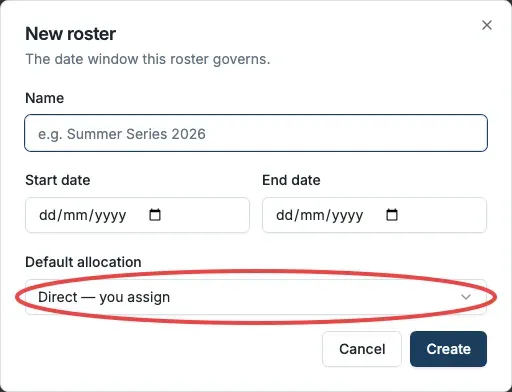
Direct — you assign
With Direct, you place every member into every duty yourself. Members get no say in the roster; they see their duties once you publish. This is the most control, and the most work, so it suits a small club where one person knows who should do what, or an event roster you want to settle by hand.
First-come — members claim
With First-come, the duties go up open and members claim the ones they want, first come first served, up to a cut-off date. You still set the roster up, but the members fill it. This works well when you have a willing pool and would rather let people pick their own dates than chase them.
Multiple choice — members offer, you fill
With Multiple choice, members do not claim a specific duty. Instead each member says how available they are on each race day, marking every day Prefer, OK or Can't. You then fill the roster from that, seeing at a glance who wants which days. It gives you the final say, like Direct, but starts from what members have told you rather than a blank grid. See Set your duty availability for the member's side of this.
Which one to choose
- Small club, you know everyone: Direct.
- Keen pool, happy to self-serve: First-come.
- You want members' input but keep control: Multiple choice.
The strategy is set per roster, so different rosters can work differently. Your club-racing roster might be First-come while a Nationals weekend is Direct.
Roster a Period is not a fourth strategy
This is the common mix-up. Roster a Period is not a way of deciding who does each duty. It is a way of building a whole stretch of the season at once: it stamps a duty-team template across every race day in a period, so you get all the slots in one step instead of one roster at a time.
Roster a Period can optionally go one step further and propose who fills each slot, using what Dockside knows about qualifications, availability and fairness. That proposal is a Direct-style draft you review and change before publishing, so it is best thought of as a smart assistant for Direct allocation, not a strategy of its own.
So the two questions are separate. The strategy answers "who decides?"; Roster a Period answers "how do I build this in bulk?" You can lay out a period and leave it for members to claim (First-come) just as easily as you can auto-propose a Direct draft. See Roster a period for how to run it.